Your Rails Are Lying to You — And Here's Why It Matters
Dead rails sabotage every shot you take, and the worst part is that most players blame their stroke long before they ever suspect their cushions. Cushion rubber degrades gradually. You don't wake up one morning to flat, lifeless rails; the bounce fades over months and years until your game feels "off" for reasons you can't quite pin down.
There are three quick tests you can run right now. First, the 4-rail draw test: shoot the cue ball with medium force into a long rail and count how many rails it reaches. If it can't make four clean bounces, your rubber is suspect. Second, the fingertip press test: press the nose of the cushion with your thumb. Fresh rubber springs back immediately; worn rubber stays compressed or feels mushy. Third, the sound test: a healthy cushion produces a crisp, consistent "thwack." A dull thud signals degradation.
Here's what many players don't realize: worn cushions transfer mechanical stress directly to the wooden rail structure. Over time, this leads to warping, cracking, and pocket misalignment. Replacing rubber early is far cheaper than repairing structural damage later. The Artemis K66 48" set, a six-rail package of tournament-grade German-manufactured rubber, is the same cushion demanded by national billiard associations worldwide. Read on for exactly what makes it the benchmark.
What Is the K66 Profile — and Why Does It Matter?
The K66 profile is defined by precise dimensions: a 1 3/16" dimensional height, a 1 1/8" top angle width, and a ball contact (nose) height of 1 3/8" to 1 7/16" above the playing surface for standard 2¼" pool balls. These measurements aren't arbitrary. They're engineered so the cushion contacts the ball at its equator, producing a predictable, consistent rebound.
K66 is the only cushion profile approved by the Billiards Congress of America (BCA). It's the industry standard for home and commercial 3-piece slate pool tables across the United States and beyond. If your table came with a K66 profile, replacing it with anything else fundamentally changes how the game plays.
This is where the most common buying mistake happens. Many players confuse K66 with K55. The K55 profile has a dimensional height of 1 5/16" and a top angle width of 1 1/4". It's designed for coin-operated and carom tables. Substituting K55 for K66 raises the playing height and alters ball rebound angles, essentially turning your pool table into a different game entirely.
Before you order, measure your nose height. Place a ball on the playing surface and check where the cushion contacts it. If the nose sits 1 3/8" to 1 7/16" above the slate, you have a K66. Getting this right before purchasing saves you the hassle of returns and ensures your new rubber performs as intended.
K66 profiles are increasingly becoming the standard for professional-level tables. The industry is shifting toward higher-density, commercial-grade rails, and K66 sits at the center of that movement.
Artemis K66 48" Set: Specs, Construction, and What Makes It Different
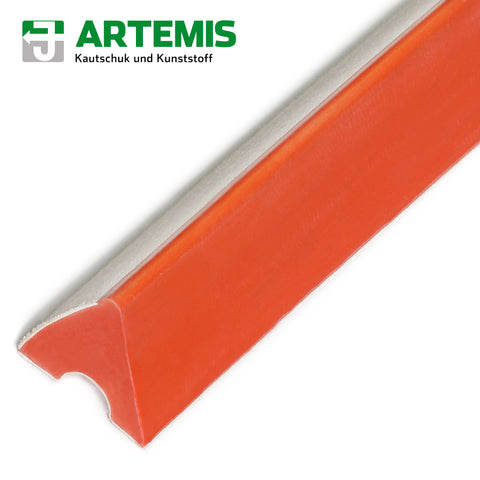
The Artemis K66 48" set ships as six cushions, each 48 inches (122 cm) long, with a net weight of 6 lb (2.7 kg). Manufactured in Germany, these cushions are instantly identifiable by their distinctive orange color, a visual marker that separates genuine Artemis rubber from lower-grade alternatives.
The rubber compounds used are what set Artemis apart at the molecular level. The company uses natural rubber formulations designated BIBA RED, TBB GREY, and KHF GREY, each blended with special additives that provide exceptional billiards suitability. These additives deliver remarkable resistance to ageing, UV exposure, humidity, and temperature fluctuations. For anyone with a table in a garage, basement, or climate-variable room, this resistance to environmental degradation is a serious practical advantage that cheaper alternatives simply don't offer.
Construction method matters enormously. Artemis K66 cushions are precision-molded with two cotton fabric backings. Molded rubber maintains dimensional consistency throughout the entire 48-inch length, meaning the nose height and rebound characteristics are identical from end to end. Cheaper extruded rubber, by contrast, is pushed through a die and often contains fillers that compromise density. The result is inconsistent bounce along the rail, something you'll feel on every bank shot.
One detail that competitor content rarely mentions: each individual Artemis cushion carries its own serial number. This isn't just a sticker. It's a full traceability system that connects your specific cushion back to its production batch. If you ever have a quality concern, that serial number gives you and the manufacturer a direct line to the manufacturing data — a trust signal that reflects genuine manufacturing rigor.
The company behind these cushions, Artemis Kautschuk und Kunststoff, has been manufacturing rubber, plastic, and metal components since 1975. They've filed over 100 patents in recent years, and their products conform to DIN EN ISO 9001:2008 quality management standards. This isn't a company that pivoted into billiards from another industry; they've spent decades refining their rubber science.
When properly maintained, Artemis K66 cushions are built to deliver 20 to 25 years of exceptional gameplay. Standard quality cushions typically lose their bounce in 12 to 15 years. For commercial venues with heavy use, standard rubber may need replacement every 5 to 7 years. The math is straightforward: paying more upfront for Artemis means fewer replacements over the life of your table, making it the more cost-effective and sustainable choice.
Table Size Compatibility: Will This Set Fit Your Table?
The 48" length is compatible with 7-foot, 8-foot, and 9-foot pool tables that use the K66 profile. On a 9-foot table, all six rails are used at their full 48" length. For 7-foot and 8-foot tables, the long rails will need to be trimmed to the correct length during installation. The short rails typically fit as-is.
Before ordering, confirm two things: your table uses the K66 profile (measure the nose height as described above), and your rails accept 48" cushions. If you're unsure, our customer service team can help you verify compatibility.
For added confidence, Artemis K66 is used by major table manufacturers including Diamond (Intercontinental No. 66). If your table is a Diamond or another premium brand, Artemis K66 is a verified, factory-spec fit.
Tournament Credibility: Who Uses Artemis K66?
Artemis cushions aren't just marketed as "tournament-grade." They're prescribed by national billiard associations for competitive play to ensure objectively comparable game results across venues and events. When a governing body mandates a specific cushion, it's because that cushion delivers measurable, repeatable performance.
Major table manufacturers rely on Artemis K66 as their factory-installed cushion. Diamond Billiard Products uses Artemis Intercontinental No. 66 in their tables, the same tables you see at professional tournaments across the country. For serious home players, installing the same rubber found on a Diamond table means your practice sessions translate directly to competition play.
Performance is quantifiable. Artemis K66 is cited alongside Brunswick Superspeed as a benchmark cushion, delivering 0.7 to 0.85 of impact velocity back to the cue ball. That range represents the sweet spot for responsive, predictable play: enough energy return for clean bank shots and kick shots, without the unpredictable "trampoline" effect of overly hard rubber.
This matters in a broader context. The global pool tables market was valued at $1.52 billion in 2025 and is growing at a 6.4% CAGR, driven by rising home entertainment investment and the expansion of pool-centric venues. The household segment held the largest market share in 2025, which tells a clear story: more homeowners are investing in refurbishing existing tables rather than buying new ones. Upgrading to tournament-grade cushions is one of the highest-impact improvements you can make to an existing table, and Artemis K66 is the standard that professionals trust.
Installation: DIY or Call a Pro?
Installing Artemis K66 cushions involves several precise steps: removing the old rubber from the rail bed, thoroughly cleaning the wood surface, applying contact cement evenly, aligning the new cushion so the nose height sits exactly 1 3/8" to 1 7/16" above the playing surface, pressing and curing the rubber, trimming any excess, and finally re-covering with cloth.
A skilled technician completes a full cushion replacement in 3 to 5 hours. A DIY attempt typically runs 8 to 12 hours, with a higher risk of misaligned rubber and torn cloth. The time difference alone is significant, but the real concern is precision.
Improper nose height alignment is the most common DIY error. Even a small deviation, a fraction of an inch, changes the ball's rebound angle and alters the playing feel across the entire table. If you're comfortable with adhesive work and have experience with woodworking or mechanical projects, a DIY installation on a recreational or practice table is reasonable. For tournament-level tables, first-time replacements, or tables already covered with expensive cloth such as Simonis 860, calling a professional is the smarter move.
One advantage of Artemis K66 is that its molded construction and dimensional consistency make alignment easier than with extruded alternatives. The cushion profile is uniform from end to end, which reduces the margin for installation error. That said, "easier" and "easy" are two different things. Respect the process, and your rails will reward you for decades.
Where to Buy Artemis K66 Rail Rubber — and What to Look For
Purchase only from authorized billiard dealers to ensure you receive genuine Artemis rubber with the individual serial number intact. Counterfeit or mislabeled K66 rubber exists in the market, and buying from unverified sellers puts your investment and your table at risk.
Billiard City carries the Artemis K66 48" set alongside other K66 options, including Championship K66 Grade A (manufactured in Taiwan) and OKKO K66 Grade BB (manufactured in China). This range lets you choose the right quality tier for your budget and use case.
Practical details that matter: Billiard City offers free shipping on US orders over $99, competitive pricing, and accepts all major payment methods including cryptocurrency (USDC). Billiard hall owners and table technicians can access wholesale pricing through our dedicated dealer portal for bulk cushion orders.
Is the Artemis K66 48" Set Right for Your Table?
Start with three checks: confirm your table uses the K66 profile by measuring nose height, verify that 48" rails are compatible with your table size, and assess your current cushion condition using the 4-rail draw test, fingertip press test, and sound test described earlier in this guide.
If your cushions are failing those tests, the Artemis K66 delivers a compelling package: a 20 to 25 year lifespan, German manufacturing backed by DIN EN ISO 9001:2008 certification, BCA approval, and endorsement by national billiard associations and manufacturers like Diamond. It's the benchmark for a reason.
We encourage you to explore the full range of cushion options at Billiard City. If you're unsure which product fits your table or your budget, reach out to our customer service team for personalized guidance. Billiard hall owners and technicians looking for volume pricing can log in through our dealer portal.
As more homeowners invest in refurbishing their existing tables rather than replacing them entirely, choosing the right cushion rubber the first time is the smartest long-term decision you can make. Your rails should never lie to you again.