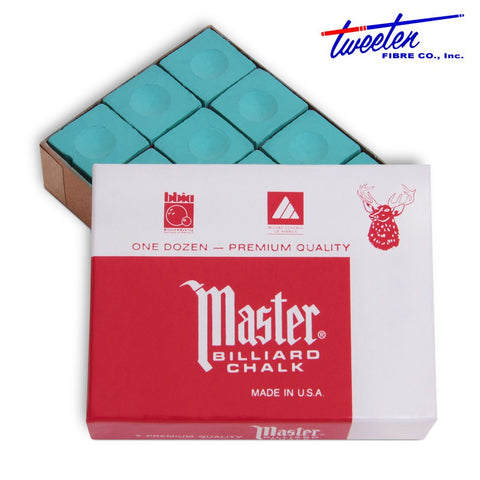
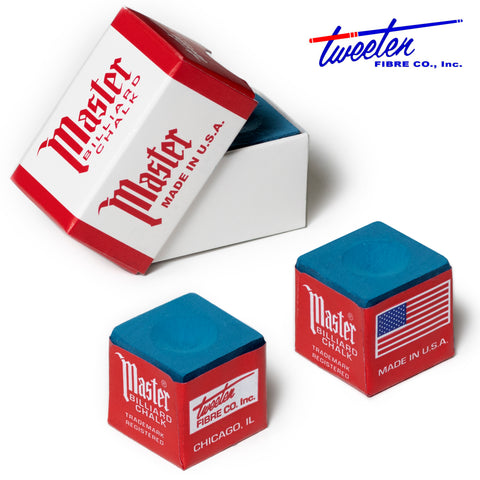
Why Master Chalk Is on Nearly Every Pool Hall Rail in North America
You can spend $1,000 on a cue and still miscue. The fix is a small cube of chalk that costs less than $2, applied correctly. That's the quiet power of Master Chalk, the undisputed industry standard found on the rail of nearly every pool hall across North America.
Manufactured by the Tweeten Fibre Company, Inc., based in Chicago, IL, Master Chalk comes from the only U.S. manufacturer of professional-grade billiard chalk and cue tips. With over 100 years of continuous production, Tweeten has earned its place as the backbone of cue sport accessories.
This article breaks down what makes Master Chalk the dominant choice, how to apply it correctly (most players don't), and who it's best suited for. With the global billiard chalk market projected to grow from $25.3 million in 2025 to $28.9 million by 2034, interest in cue accessories is clearly on the rise. Make sure you're getting the most out of the one accessory every player uses.
What Is Master Chalk? A 100-Year American Legacy
Tweeten Fibre Company has been manufacturing billiard chalk and cue tips for over a century from their facility on West Hubbard Street in Chicago. They are the sole domestic producer of professional billiard chalk in the United States, a distinction that carries real weight for players and club owners who prioritize American-made products.
A common misconception worth clearing up: modern billiard chalk is not blackboard chalk. It contains no calcium carbonate. Instead, it's composed of fine abrasives like silica and aloxite, engineered to create friction between the cue tip and the cue ball. The old calcium carbonate formulas, used through most of the 1800s, produced excessive dust that stained cloth and balls.
The history goes further back than most players realize. Chalk was used to increase friction between the cue and the ball even before leather tips existed. The leather cue tip was perfected in 1823, and that innovation opened the door to side-spin (English) for the first time. But the chalk had to evolve too.
Credit for the modern formula goes to William A. Spinks and William Hoskins, who developed the silica-and-aloxite composition that dramatically reduced dust while improving a player's ability to apply English. Their work laid the foundation for what Master Chalk is today.
Tweeten Fibre's portfolio extends beyond Master Chalk. They also produce Triangle Chalk, along with Elk Master, Le Pro, and Triumph cue tips. It's a full-service cue accessories operation, and the Master Chalk line sits at the center of it all. Proudly manufactured in the USA, it holds a meaningful edge for buyers who care about domestic sourcing and consistent quality control.
Master Chalk Colors: More Than Cosmetic — How to Match Chalk to Your Cloth
Master Chalk is available in 12 colors: Blue, Black, Brown, Burgundy, Forest Green, Green, Gold, Gray, Rust, Red, Sky Blue, and Spruce. That's a wider palette than most players expect from a chalk brand.
Color has zero effect on performance. The choice is entirely practical and aesthetic. The core benefit of picking the right color is simple: matching your chalk to your table cloth minimizes visible chalk marks and residue on the playing surface. Green chalk on green Simonis cloth, for example, keeps things looking clean.
This matters more than you might think. On premium cloth like Simonis, chalk residue can accelerate wear and increase cleaning frequency. Choosing a chalk color that blends with your cloth reduces visible staining and can meaningfully extend cloth life over time.
For home game room owners, color-matching chalk is one of the easiest and most affordable ways to keep your setup looking sharp. For billiard club owners and pool hall managers, selecting the right chalk color for house cues is a practical maintenance decision. On high-traffic tables that see dozens of players a day, reducing visible chalk marks keeps the room looking professional without extra labor.
How to Apply Master Chalk Correctly (Most Players Get This Wrong)
Walk into any pool hall and watch how people chalk their cues. Most players twist the cue tip into the chalk cube like they're screwing in a lightbulb. This is the single most common mistake in billiards, and it causes three problems: uneven coating, wasted chalk, and a hollowed-out cube that becomes unusable well before it should.
The correct technique is straightforward. Brush the chalk lightly across the tip in smooth, overlapping strokes. Rotate the cue slightly as you go to coat the entire tip face evenly. Think of it like painting, not drilling. You want full, even coverage across the tip's surface.
How often should you chalk? If you're applying heavy spin or English, re-chalk before every shot. For standard shots without much side-spin, every two to three shots is acceptable. Under normal use conditions, a single cube of Master Chalk typically lasts two to four weeks of regular play.
One detail many players overlook: chalk can only do its job if the cue tip is in good condition. A worn or glazed tip will miscue even with perfect chalk application. When leather hardens and loses its texture, chalk has nothing to grip. If you're experiencing miscues despite chalking regularly, lightly scuff the tip with a tip tool to restore adhesion. That small step makes a significant difference.
One more factor to consider: humidity. Moisture in the air affects chalk adhesion and residue behavior. If you play in a humid environment, store your chalk in a dry, closed container to preserve its performance and prevent premature degradation.
Master Chalk vs. Premium Chalks: Understanding the Value Proposition
To be straightforward about performance data: in comparative miscue testing, Master Chalk allowed approximately 8 hits before a miscue per application. Kamui allowed 15, and Magic Chalk allowed 29. That places Master in the mid-to-lower range for miscue prevention per single application.
So why does it remain the dominant chalk on the market? Several reasons. Consistency, universal availability, and price-per-cube economics all work in Master Chalk's favor. A single cube of premium chalk can cost 10 to 20 times more than a cube of Master. The practical reality: correct technique closes much of the performance gap. A player who chalks properly before every shot with Master Chalk will miscue far less often than someone using premium chalk with poor habits.
For recreational and intermediate players, Master Chalk's performance is more than adequate. The difference in miscue rate matters most to competitive players grinding through long sessions with heavy English on every shot.
Chalk-tip pairing is another factor worth understanding. Master Chalk's texture works particularly well with standard leather tips, the kind most recreational and intermediate players use. Soft tips hold chalk longer, while hard tips require more frequent application. If you're using a standard soft or medium leather tip, Master Chalk is a natural fit.
Premium options like Kamui and Taom are gaining traction. Taom became the Official Global Chalk Partner of the World Seniors Snooker Tour in September 2025, signaling growing brand competition at the top end. But Master Chalk isn't trying to be the premium option. It's the trusted, proven baseline: the ideal entry point for new players and a reliable house standard for clubs. That's a deliberate, economical choice, not a compromise.
Buying Master Chalk: Individual Cubes, Dozen Boxes, and Gross Bulk Orders
Master Chalk is sold in two primary formats: boxes of 12 (a dozen) for individual players, and gross boxes of 144 cubes for billiard clubs, pool halls, and sports bars. The format you choose depends on how much chalk you go through.
For club owners, the cost-per-session math is compelling. At two to four weeks per cube under regular play, a gross box of 144 cubes provides substantial operational runway. The per-unit cost drops significantly at that volume, making it one of the most economical consumable expenses in running a billiard room.
Pool halls, social gaming lounges, and pool league venues are a growing bulk-purchasing audience. As the broader billiards and snooker equipment market continues to expand (valued at $3.2 billion in 2025 and projected to reach $5.1 billion by 2034), demand for reliable house supplies like Master Chalk is rising with it.
At Billiard City, we carry Master Chalk and offer free shipping on all US orders over $99, which makes bulk gross box orders especially cost-effective for club owners and dealers. Our wholesale and dealer program is also available for billiard club owners and pool hall managers seeking authorized product at scale.
For buyers who prioritize domestic sourcing, it's worth repeating: Master Chalk is the only professional billiard chalk manufactured in the United States. No other chalk brand can claim that distinction.
Is Master Chalk Right for You?
Master Chalk is the 100-year American standard: consistent, affordable, widely available, and offered in 12 colors to match any cloth. It's not the highest-performing chalk in a lab test, and we've been transparent about that. But performance on the table depends far more on technique than on the cube in your hand.
Correct application is the single most impactful variable. Even the best chalk underperforms on a glazed tip or when a twisting motion hollows out the cube.
We recommend Master Chalk for:
- Recreational home players looking for reliable, affordable chalk
- Intermediate players building their game and developing proper habits
- Billiard clubs and pool halls seeking an economical, dependable house chalk
Serious competitive players may benefit from exploring premium chalk options for tournament play. But Master Chalk remains a trusted baseline that pros and amateurs alike rely on every day.
Browse Master Chalk and our full range of billiard accessories at Billiard City. With a 4.7-star rating across 78 verified reviews and free shipping on US orders over $99, we're here to help you find exactly what your game needs.