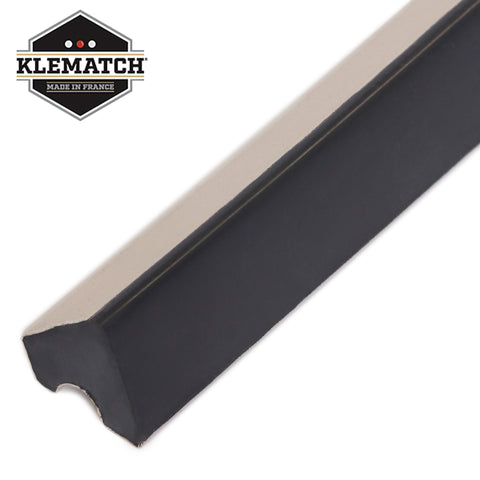
What Is the Klematch P37 Carom Table Rail Rubber?
The Klematch P37 is a quadrangular-profile rail rubber engineered exclusively for pocketless carom billiard tables. It is not interchangeable with the triangular P59 profile used on pool tables or the L-profile found on snooker tables. Each profile is geometry-specific, designed for a particular table type and ball size.
The "P37" designation refers to the 37mm rail nose height specification, precisely calibrated for the 65mm carom ball diameter. If you have searched for "Kleber #37" or "Clipatch P37," you have already found the right product. Those are legacy European names for the same cushion lineage. The Klematch P37 is the de facto standard cushion profile used on professional carom tables in international tournaments worldwide, making it the benchmark for rebound quality and geometric precision.
French Manufacturing Heritage: From Kleber to Klematch
Understanding the Klematch name starts with its origins. The brand was formerly known as Kleber, a French rubber manufacturer founded in 1910. The company now operates as Anvis Decize S.A.S. (also referenced as SumiRiko Industry France S.A.S.), based in Decize, France. Its industrial expertise spans anti-vibration components, technical elastomers, and rubber-metal assemblies — the same rubber science that underpins every Klematch billiard cushion.
With over 40 years of rubber manufacturing heritage applied specifically to billiard cushions, Klematch brings industrial-grade precision to a product that demands it. All Klematch cushions are manufactured in France using natural rubber-based compounds, with no synthetic fillers that degrade performance over time. This Made-in-France origin is a genuine quality differentiator, especially as buyers pay closer attention to where their equipment is actually produced.
The Kleber-to-Klematch name transition explains why some buyers searching "Kleber #37" land on Klematch product pages. Both names refer to the same lineage, the same factory, and the same commitment to precision rubber manufacturing.
Molded, Not Extruded: Why the Manufacturing Process Matters
Here is a technical distinction that most buyers never encounter in competitor product descriptions: the Klematch P37 is molded, not extruded. This matters more than it might sound.
Extrusion pushes rubber through a die to form a continuous strip. While efficient, this process can introduce dimensional variance along the length of the rubber. Those small inconsistencies translate directly into inconsistent rebound angles, something that undermines shot accuracy in any discipline but is particularly damaging in carom play.
Molding, by contrast, produces a geometrically regular, consistent profile from one piece to the next. The P37's quadrangular shape retains its profile geometry under repeated impact. Extruded or filler-based cushions tend to compress unevenly over time, developing dead spots where the rubber no longer returns the ball with predictable energy and angle.
Another critical advantage: Klematch P37 rubber does not dry out or harden over time. Lower-grade alternatives gradually lose elasticity, producing muted, unpredictable rebounds that frustrate players and degrade table quality.
In carom disciplines like 3-cushion, 1-cushion, and straight rail, cushion rebound precision is a core gameplay element, not a secondary feature. Every shot calculation depends on predictable angles off the rail. Choosing a molded cushion over an extruded one is not a luxury; it is a practical decision that protects the integrity of the game.
Rail Nose Height and the 37mm Specification
Rail nose height is the distance from the outer nose point of the cushion to the slate surface. For the P37 profile, this measurement must be exactly 37mm (±1mm). That tight tolerance exists for a reason.
Even a 2mm deviation from spec causes ball hop on contact, disrupting the smooth, low-angle rebounds that carom play depends on. Players who notice their balls bouncing slightly off the cushion after a re-rubber job are often dealing with a rail height problem, not a rubber quality issue.
Before installation, measure the rail nose height with a reliable gauge. If the table's existing sub-rail does not meet the 37mm spec, shimming is necessary to bring the height into tolerance. This step is straightforward but essential. Use appropriately sized shims between the cushion and the sub-rail to achieve the correct measurement.
Improper rail height is one of the most common, and most overlooked, causes of inconsistent play on carom tables after a cushion replacement. Getting this right is worth the extra few minutes of setup.
When to Replace Your Carom Table Cushions
Carom cushions require more frequent replacement than pool table cushions. The reason is straightforward: rebound precision is central to carom gameplay. Even slight hardening of the rubber noticeably affects ball response, and experienced players feel the difference immediately.
Watch for these signs of worn cushion rubber:
- Dead or muted rebound, where the ball comes off the rail with less energy than expected
- Inconsistent angles, particularly noticeable in multi-cushion shots
- Visible cracking or surface crazing on the rubber
- Ball hop on cushion contact
Pool table cushions can last 20 to 25 years under light residential use, but they may fail in as few as 5 to 10 years under heavy commercial play. Carom cushions in active club environments may need replacement sooner, given the intensity of cushion-dependent play that defines the discipline.
Environmental factors accelerate degradation as well. Prolonged UV exposure, high humidity, and temperature extremes all harden rubber compounds faster than normal use alone. If your table sits near windows or in an unconditioned space, inspect the cushions more frequently.
For billiard hall owners and table technicians, the best practice is to inspect cushion rebound quality on a regular schedule rather than waiting for visible damage. Proactive replacement protects table performance and player experience, and it prevents the slow decline that players notice before management does.
What's in the Set: Coverage and Sizing Details
The Klematch P37 is sold as a set of 3 pieces, each 302 cm (approximately 119 inches) long. This provides full coverage for a professional-size 10-foot carom table. The set of 3 covers the three long rails of a carom table, which has a different rail configuration than a pool table.
For 8-foot or 9-foot carom tables, the cushion pieces can be cut to the required length. Standard woodworking or rubber-cutting tools work well for this. Make cuts cleanly and squarely to ensure flush contact at the mitered corners.
Before ordering, measure your existing cushion lengths to confirm fit. This is especially important on non-standard or vintage carom tables, where dimensions may differ slightly from modern specifications.
Billiard City sells the Klematch P37 Carom Table Rail Rubber 302 cm Set of 3 at $795.00, with free delivery and free returns. As an authorized dealer carrying over 2,000 billiard products across 50+ brands, Billiard City is your single trusted source for this product.
Klematch P37 vs. Artemis P71: Choosing the Right Carom Cushion
The Artemis P71 is the primary alternative carom cushion profile on the market, available at a lower price point (approximately $400 to $699). Artemis is a Belgian brand with its own respected lineage in billiard equipment manufacturing.
Community players and table technicians report that the P37 and P71 profiles are functionally interchangeable on most modern carom table sub-rails. Both conform to the 37mm nose height standard, and both perform well under normal playing conditions.
The distinction comes down to manufacturing origin and long-term performance. The Klematch P37 is molded in France with over 40 years of billiard-specific rubber expertise, using natural rubber compounds that maintain their elasticity over the life of the cushion. For tournament-grade tables, professional clubs, and players who prioritize the highest rebound consistency and long-term durability, the P37 is the premium choice.
That said, the Artemis P71 may be a practical option for budget-conscious buyers or lower-traffic home tables. We believe in giving you an honest comparison so you can make the right decision for your table and your playing needs.
Why Carom Players and Hall Owners Trust Klematch P37
The reasons professionals choose the Klematch P37 come down to fundamentals: tournament-proven profile geometry, molded manufacturing precision, French natural rubber compounds, and a brand heritage spanning over a century. The P37 is the standard cushion profile used in most international carom tournaments, making it the logical choice for any club or hall that hosts competitive play.
With the global billiard halls market valued at $2.37 billion in 2024 and projected to grow at 4.2% annually through 2033, hall owners investing in premium table components are protecting both their equipment and their reputation.
Take a moment to inspect your current cushions. Are your rebounds consistent? Do your angles hold true across all three rails? If the answer is anything less than confident, it may be time for a replacement.
The Billiard City team is here to help with any questions about compatibility, installation, and sizing. We are committed to making sure you get the right product for your table, and we will walk you through the details personally. That is what we do.