Why Your Rails Matter More Than You Think
If your bank shots keep coming up short or your rebounds feel unpredictable, your stroke might not be the problem. Dead rails are one of the most overlooked causes of inconsistent play, and because pool table cushions degrade slowly over years, most players never suspect the rubber beneath the felt.
Here's a quick field test: roll a ball hard across the short rail of your table. A healthy cushion will send that ball rebounding three to four times before it stops. Fewer bounces means your rubber is compromised.
This guide covers everything you need to know about K66 pool table rail rubber, why Championship's lineup is the benchmark, how to choose the right tier for your table and budget, and when it's time to replace your cushions entirely.
What Is K66 Profile Rail Rubber?
K66 is the industry-standard cushion profile for pool tables. If you own a 3-piece slate table (and it's not a Brunswick), there's an excellent chance your table uses K66 profile rubber. It's the most common profile found on both home and commercial pool tables across the country.
The dimensions matter. K66 cushions have a height of 1 3/16", a top angle width of 1 1/8", and a ball contact point (the "nose") that sits exactly 1.43" above the playing surface. These measurements are engineered for standard 2¼" pool balls.
When the nose height is off, even by a fraction, the ball's rebound angle shifts. Too high and the ball kicks downward into the slate. Too low and it launches upward off the rail. No amount of stroke adjustment fixes a geometry problem built into the rubber itself.
Not every table uses K66. Older Brunswick tables manufactured before 1975 typically require K55 profile cushions. Carom tables and coin-operated tables also tend to use K55. Some home and commercial tables use the U23 profile. If you're unsure which profile your table needs, checking the manufacturer's specs or measuring the existing cushion cross-section is the safest approach.
One critical distinction: K66 is the only cushion profile officially approved by the Billiards Congress of America (BCA). For league play, tournament certification, and billiard club compliance, BCA approval isn't optional. If your venue hosts sanctioned events, K66 is the required profile.
Championship's Three-Tier K66 Lineup Explained
Championship has been a leading supplier of cushion rubber to the billiard industry for decades. They use American-made tooling and maintain strict quality control across every production run. Their approach to K66 rubber follows a clear three-tier structure, similar to how players think about upgrading cues: entry-level reliability, mid-range performance, and top-tier precision.
Tier 1: Standard K66 (Grade A)
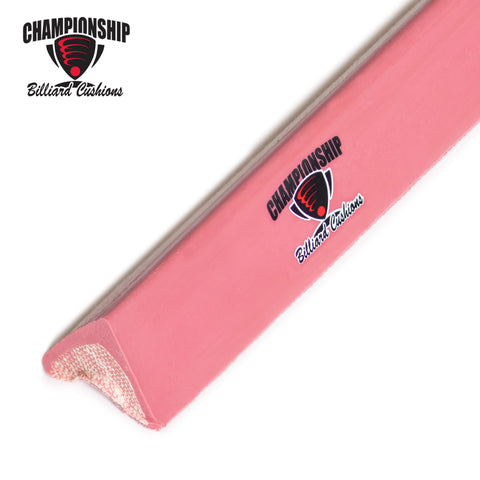
The Standard K66 is manufactured in Taiwan using Grade A rubber. It's available in 42" sets (fitting tables up to 8 feet) and 48" sets (for 9-foot tables). The 48" set retails at $65.95. This is the reliable entry-level choice for home tables, delivering BCA-compliant performance without a premium price tag.
Tier 2: Mercury K66 (Premium Grade)
The Mercury K66 steps up with canvas-backed construction and is made in the USA. Available in 41" and 47" lengths, the 47" set retails at $109.95. Canvas backing matters for two practical reasons: it provides a superior adhesion surface during glue-up, and it reinforces the rubber's structural integrity over years of play. USA manufacture also means tighter quality control tolerances throughout the production process.
Tier 3: Tour Edition K66 (Top-Tier)
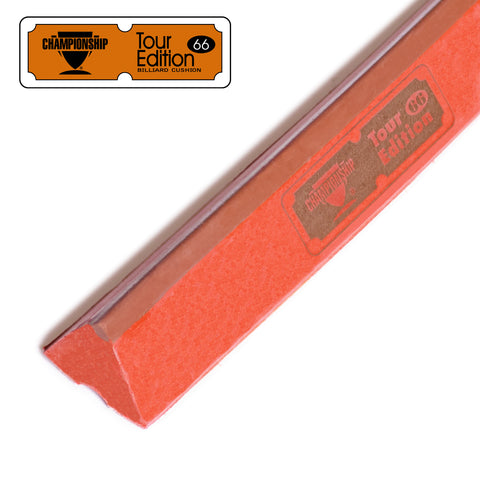
The Tour Edition K66 is Championship's flagship cushion. It features a patent-pending dual-density rubber formula that has been tested 100% accurate at all speeds. Available in a 47" length that fits any 7', 8', or 9' table, the set retails at $157.00. This is the cushion of choice for many leading billiard table manufacturers, and it represents the highest-performing K66 option available at the consumer level.
A performance detail worth noting: Championship's internal testing showed that both their Standard K66 and Mercury lines met BCA accuracy standards 100% of the time at all three test speeds, a benchmark no competitor cushion tested achieved. The Tour Edition, with its dual-density construction, pushes consistency even further.
All three Championship K66 tiers are available exclusively on Billiard City.
Which Championship K66 Tier Is Right for You?
Choosing the right tier comes down to how you use your table and what you expect from it.
Standard K66 is the smart pick for recreational home players on a budget, occasional-use tables, or anyone replacing cushions for the first time. It's BCA-compliant, proven, and gets the job done without overspending.
Mercury K66 fits serious home players, game room enthusiasts upgrading aging tables, or light-commercial settings. The canvas-backed durability and USA manufacture justify the mid-range price, especially on tables that see regular weekly play.
Tour Edition K66 is built for competitive players, billiard club owners, and multi-table operators. The 47" universal length simplifies bulk ordering across mixed table sizes, and the dual-density formula delivers the most consistent rebound behavior available.
For commercial operators specifically: bars, pool halls, and game rooms running multiple daily sessions may need cushion replacement every 2 to 4 years. The Tour Edition's performance consistency and universal sizing make it the logical bulk-replacement choice. Billiard City's wholesale/dealer program is available for club owners and dealers seeking authorized, US-shipped Championship product at volume.
Sizing Your K66 Rubber: Matching Length to Table Size
Getting the right length for your table is straightforward. Here's the breakdown:
- Standard K66: 42" set of 6 fits tables up to 8 ft; 48" set of 6 fits 9 ft tables
- Mercury K66: 41" fits 7–8 ft tables; 47" fits 9 ft tables
- Tour Edition K66: 47" fits any 7', 8', or 9' table, making it the single versatile SKU for operators managing multiple table sizes
One important rule: always replace cushions as a complete set of 6. All six rails degrade at roughly the same rate. Replacing only one or two creates inconsistent rebound behavior across the table, which undermines the entire playing surface. Even if one rail feels slightly better than the others, they're all the same age and have absorbed the same cumulative impact.
Installation Basics: What to Know Before You Glue
DIY cushion installation is increasingly popular among home players, and it's entirely doable with the right preparation. The most common mistake is orienting the rubber incorrectly: the notched side of the K66 cushion must face and be glued against the wood rail, with the canvas or smooth top side facing upward toward the playing surface. Reversing this will ruin your rebound geometry.
After installation, verify that the nose height sits at 1.43" above the playing surface. If it's off, you'll get the same unpredictable deflection angles that prompted the replacement in the first place.
Canvas-backed rubber (like the Mercury K66) provides a better adhesion surface during gluing compared to non-backed rubber, a practical installation advantage beyond long-term durability. Replace all six cushions in a single session to ensure consistent rubber age and compression across the entire table.
When to Replace Your Pool Table Cushions
Replacement timelines vary significantly based on how heavily the table is used:
- Occasional home use: Quality cushions can last 20 to 25 years. Tables played only a few times a month may go 8 to 15 years before needing work.
- Regular home use (several times per week): Expect to replace cushions every 4 to 8 years.
- Commercial venues (bars, pool halls, league venues): With multiple daily games creating continuous impact and compression, replacement cycles shorten to every 2 to 4 years.
When in doubt, use the field test: roll a ball hard across the short rail. Three to four rebounds means healthy rubber. Fewer bounces means it's time.
The global pool tables market, valued at roughly $1.52 billion in 2025 and projected to reach $1.61 billion in 2026, continues to grow. Aftermarket refurbishment, including felt and rubber replacement, represents a growing recurring revenue stream for club operators. If one rail is dead, the others are likely close behind. Replace all six at once.
Why Buy Championship K66 from Billiard City
Billiard City is an authorized Championship dealer, not a gray-market reseller. Every K66 set you purchase ships as genuine Championship product with full quality assurance. That distinction matters when you're investing in components that affect every shot on your table.
Orders over $99 ship free within the US, and every Championship K66 set qualifies at every tier. Club owners and dealers can take advantage of Billiard City's wholesale/dealer program for bulk authorized product shipped domestically.
With a 4.7-star rating across 78 verified reviews, Billiard City has built a track record of exceeding customer expectations. All three Championship K66 tiers (Standard, Mercury, and Tour Edition) are available exclusively through Billiard City, making it the single destination for the full lineup.
The Right Rails Make Every Shot Count
Cushion quality directly affects gameplay accuracy. No stroke adjustment compensates for dead or non-compliant rails. The fix is mechanical, not technical.
To recap: the Standard K66 delivers BCA-compliant performance at $65.95 for budget-conscious home players. The Mercury K66 adds canvas-backed, USA-made durability at $109.95 for serious players and light-commercial use. The Tour Edition K66 provides the highest precision available with dual-density rubber at $157.00 for competitive players and commercial operators.
Use the rebound field test and the replacement timelines above to assess your current cushions. If they're not performing, the fix is straightforward. Visit Billiard City's Championship K66 listings for the full lineup, with free US shipping on every set.